Tree Ordination: Preserving Nature through Spiritual Connection
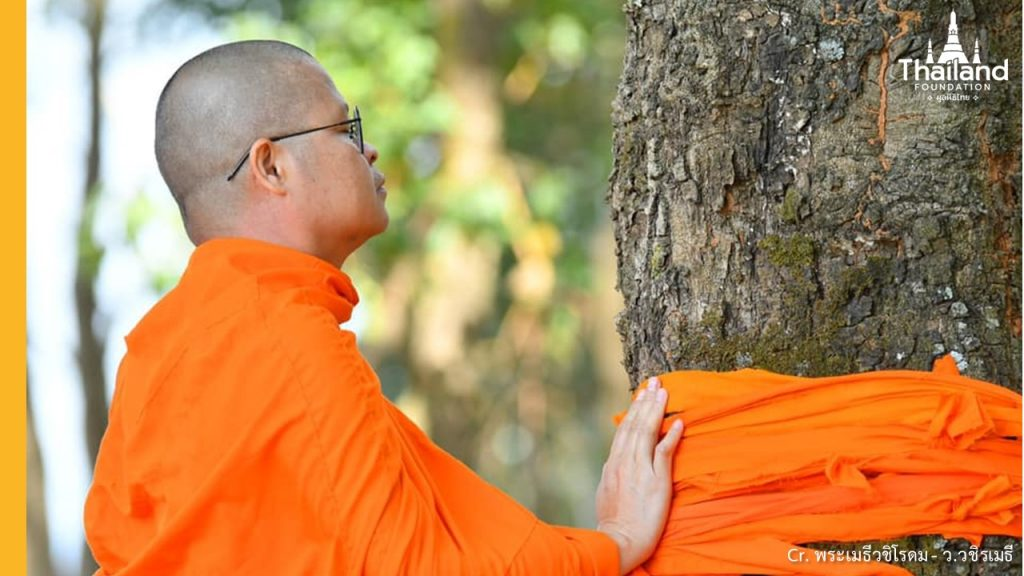
Tree ordination, or buat ton mai (บวชต้นไม้) is a ceremony whereby a tree is symbolically ordained as a monk in order to protect it from loggers. To truly understand this process, one must first understand the Thai Buddhist concept of ordination.
In Thailand, the ordination is a process whereby a lay Buddhist practitioner, specifically male, transitions into monkhood and is accepted into the monastic community (known as the Sangha). Once ordained, Buddhist monks must adhere to strict monastic laws while practicing the Dharma, teachings of the Buddha, to the fullest extent in order to achieve Nirvana or Nibbana. Buddhist monks are also expected to learn, preserve, and propagate Dharma, helping guide others away from suffering and towards meaningful happiness.
These acts meant that monks are often held in highest regards within Thai society. Performing good deeds upon a monk, such as offering alms or clothing, is believed to generate great merit for the individual. Harming a monk, on the other hand, will lead to the accumulation of severe bad karma or kamma.
A tree ordination ceremony is performed in areas where people wishes to protect the flora against deforestation. In a classic tree ordination ceremony, the community first selects the phaya ton mai (พญาต้นไม้), the largest and most significant tree within the area, to receive the ordination. It is believed that the phaya ton mai functions as the leader of all other trees within the area. Some forests may only have one phaya ton mai, while other forests may have multiple. Offerings are made to the sprits of the forest, followed by the erection of a shrine for the spirit inhabiting the phaya ton mai and more offerings being made to Phra Mae Thoranee (Mother Earth). After this, a shaman will call upon the spirit of the phaya ton mai to remain and protect the phaya ton mai as well as the other trees of the forest. The shaman will also ask other spirits of the forest to punish those who harm the trees.