-
Gateway One: Introduction
Overview -
Welcome letter
-
Background to OneSpirit becoming a nominating body and the role of nominator – Interview with Rev Jane Patmore
-
Requirements for authorisation
-
Gateway Two: Legal marriage and civil partnership in ScotlandLegal Paperwork Process
-
Ceremony requirements
-
Frequently asked questions for you to reflect on
-
Gateway Three: AuthorisationYour first legal marriage or civil partnership
-
Subsequent legal marriages or civil partnerships
-
Your authority for each ceremony
-
Registered celebrant status (the 'permanent' register)
-
Removal from the registers
-
Gateway Four: The practicalities of holding a legal ceremonyBefore the Ceremony Filling in the Marriage Schedule
-
On the Day
-
Signing the Schedule
-
After the Ceremony
-
Knowledge Test1 Quiz
-
Gateway Five: Next steps after completing this online courseNext steps after completing this course
-
ResourcesUseful Contacts/Links
-
Key documents
-
Draft Letters of Application

Ceremony requirements
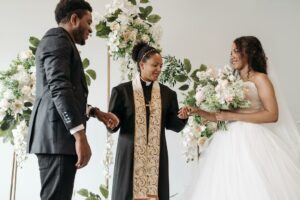
There is no legally prescribed form of words for marriage vows in Scotland. The ceremony can be conducted in English or in any other language, provided all present, both parties, the celebrant and both witnesses, can understand it.
Where anyone cannot, an interpreter must be present.
The ceremony must take place in the presence of two witnesses, each aged 16 or over and capable of understanding the proceedings.
Both parties must state their full names as recorded on the Schedule (first and last names; middle names are optional).
The detail of the ceremony is decided by you with the couple. But the form of ceremony for a mixed-sex marriage must include, and must in no way be inconsistent with:
- a declaration by the parties, in the presence of each other, the celebrant and two witnesses, that they accept each other as husband and wife, or accept each other in marriage, or both; and
- a declaration by the celebrant, after the parties’ declaration, that they are then husband and wife, or are then married, or both.
The form of ceremony for a same-sex marriage must include, and must in no way be inconsistent with:
- a declaration by the parties, in the presence of each other, the celebrant and two witnesses, that they accept each other in marriage; and
- a declaration by the celebrant, after the parties’ declaration, that they are then married.
Which set of declarations applies is determined by the legal sex of the parties as recorded on the Schedule, so check the Schedule in advance and never assume. Asking every couple which wording they would like to use is a respectful way to open the conversation; mixed-sex couples have a genuine choice between the two forms.
A civil partnership is formed when the second of the two parties signs the Civil Partnership Schedule. No spoken declaration is required, and the law does not prescribe a form of ceremony. Most couples choose to have a ceremony around the signing, and you can shape something meaningful and personal, but be clear with the couple that the legal moment is the signing itself, and give it the attention it deserves.
Full guidance, including worked examples, is in Annex A of the framework.